Coyoacán and Casa Azul: Frida Kahlo's Blue House in Mexico City
Coyoacán is one of Mexico City's most atmospheric neighborhoods, a leafy, village-like pocket of plazas, churches, markets, and cafés in the south of the city, and home to Casa Azul, the cobalt-blue house where Frida Kahlo was born, lived, and died. Both times I have visited, it is where I went to breathe after the intensity of Día de Muertos, or Day of the Dead. If you want the softer, slower side of the city, this is it.
Where is Coyoacán, and how do you get there?
Coyoacán sits in the southern part of Mexico City, far enough from the historic center to feel like its own small world. The name means "place of coyotes," and you will find them cast in bronze in the fountain at the heart of the main plaza. Cobblestones, tree-shaded squares, street vendors, and a gentler rhythm make it one of the easiest places in the city to simply wander.
From the Centro it is roughly thirty to forty-five minutes by car or rideshare depending on traffic, or a ride on Metro Line 3 to the Coyoacán or Viveros stations and a pleasant fifteen-minute walk from there.
What is Casa Azul, Frida Kahlo's Blue House?
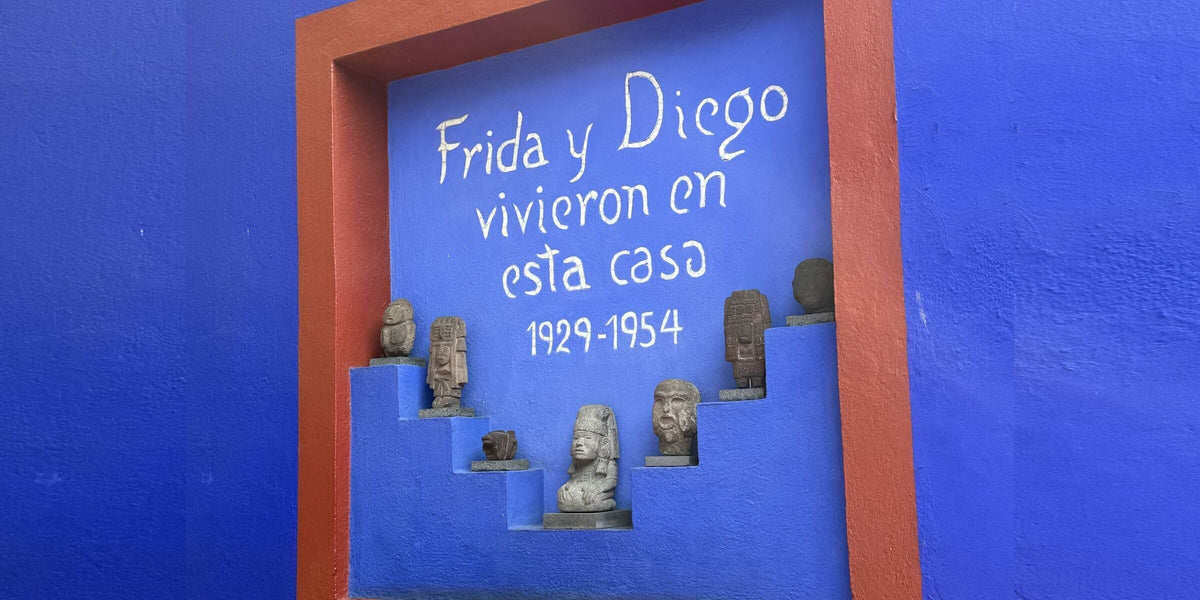
The neighborhood's most famous anchor is Casa Azul, now the Museo Frida Kahlo, on the corner of Londres and Allende. Frida was born in this house, painted in it, and died in it, and Diego Rivera turned it into a museum four years after her death. It is intimate rather than grand, cobalt walls, garden paths crowded with plants, her studio, her bed with the mirror above it, her dresses and corsets, her books, and the sense that her life still lingers in the rooms. This is not a museum to rush through. It rewards the visitor who slows down and looks closely.
Do you need to book Casa Azul tickets in advance?
Yes, and this is the single thing that will save your trip. Tickets are sold online only, for a timed entry slot, and they sell out weeks ahead in the quiet months and months ahead around Día de Muertos. Turning up at the door hoping for entry is how people end up disappointed. The simplest way in is to book a guided visit through my Walk Rylee's Mexico City journey, where the tours that include Casa Azul handle the timed entry for you. Two more things to know. The museum is closed on Mondays, and it opens an hour later on Wednesdays. Pick a morning slot if you can, and give yourself the rest of the day for the neighborhood.
Who was Frida Kahlo, and what does Casa Azul represent?
Frida Kahlo was born in this house in 1907 and died in it in 1954, at forty-seven. Polio at six left her with a withered leg. At eighteen, a bus accident broke her spine and pelvis and put her in pain for the rest of her life, through more than thirty operations. She began painting flat on her back, with a mirror fixed above the bed so she could use the one subject she always had, herself. She married the muralist Diego Rivera in 1929, divorced him ten years later, and married him again the year after that. She was a committed communist, fiercely political, and she painted the things women were not supposed to paint, her miscarriages, her broken body, her Mexican identity, at a time when almost no one did.
Casa Azul holds all of it. When I walked in, what stopped me was the beauty of the courtyard, and then the way the house is set up to still be her home rather than a museum about her. You can sense what her life was like in those rooms, the pain and the color side by side. This is not a monument to a famous painter. It is the house of a woman who refused to look away from her own life, and who made something the whole world still comes to see.
What else is there to do in Coyoacán?
Do not treat Coyoacán as only a stop for the museum. Leave time to sit in the plaza by the coyote fountain, wander the Mercado de Coyoacán for tostadas and fruit, find a café under the trees, and let the color of the place settle into you. A few blocks from Casa Azul is Casa Roja, the Kahlo family home that opened as a museum run by her relatives, and it makes a quieter, less crowded companion visit. After the crowds and emotion of the cemetery and the parade, Coyoacán gives the journey room to exhale.
Where Rylee stood
In Monarch of the Heart, Coyoacán is the chapter where the city finally exhales. Rylee walks into Casa Azul beside Joaquín and stops without realizing she has stopped, first at the blue, then at the doorway of Frida's bedroom, where the mirrors above the bed angle down to force a broken body to see itself. No romance in it, no attempt to make suffering beautiful, only the refusal to look away. I gave Rylee that doorway because it is the one that stopped me.
Why it belongs on the marigold path
Art preserves a life differently than memory does, but both ask the same thing of us, to pay attention. That is why Coyoacán matters to the world of the novel. It is a place that teaches you to notice, to slow down, to let beauty do its quiet work. Frida turned her pain into something the whole world still comes to see. There is a lesson in that for anyone carrying something heavy.
If you want to walk it with a guide, my Walk Rylee's Mexico City journey is built around exactly this, the food, art, and neighborhoods that give the city its soul. You can also download my free reader's travel guide, which walks the whole marigold path behind the novel, and if you have not met Rylee yet, read the first chapter free before you go.
Some travel links on this page are affiliate links, which means Monarch & Marigold may earn a small commission if you book through them, at no additional cost to you.
Buen camino,
Carrie