How to Build an Ofrenda: A Beginner's Guide to the Día de Muertos Altar
An ofrenda is a home altar built during Día de Muertos, or Day of the Dead, to welcome the spirits of loved ones back for a visit. It holds their photos, their favorite foods and belongings, marigolds, and candles, all arranged as a warm invitation home. If you want to honor someone you have lost, you do not need anything fancy to begin.
I know, because I started mine out of grief.
I was twenty-six when my dad died of a heart attack, scuba diving, while I was on my honeymoon. It was two days after he walked me down the aisle. In the years that followed, I needed a way to keep him close that felt like more than a photo on a shelf. The ofrenda gave me that. Every year I build one for him, and every year he comes back to me a little, in the objects and the marigolds and the candlelight.
Here is how to build your own.
What is an ofrenda?
The word ofrenda means “offering.” During Día de Muertos, families build these altars in their homes to welcome back the spirits of those who have died. The tradition holds that on these nights the veil between worlds grows thin, and the dead return to visit the living. The ofrenda is how you make them feel expected. You set out the things they loved so that when they arrive, they know they are home.
It is not somber. That is the part that surprises people. An ofrenda is built with color and food and laughter and memory. It is a celebration of a life, not a mourning of a death.
What do you put on an ofrenda?
A traditional ofrenda holds photos, marigolds, candles, copal incense, water, salt, food, and papel picado, and each one has its own meaning. You do not need every one to start, but here is what they are and why they belong.
Photos of your loved ones. The heart of the altar. These tell the spirits, and everyone who visits, exactly who is being honored.
Marigolds (cempasúchil). The bright orange flower of the dead. Its color and its scent are believed to guide spirits home, so people lay petals in paths leading to the altar. If you have read Monarch of the Heart, you already know why this flower runs through everything I make.
Candles. Light to guide the way through the dark. Many families light one for each loved one being remembered.
Copal incense. Its smoke is believed to cleanse the space and carry prayers upward.
Water. A glass set out to quench the thirst of spirits after their long journey back.
Salt. A small dish, for purification.
Food and favorite things. This is where the altar becomes personal. You set out the dishes, drinks, and objects your loved one adored in life. Pan de muerto, the sweet “bread of the dead,” is traditional, but the most meaningful offerings are the ones that were truly theirs.
Papel picado. Delicate cut-paper banners that flutter in the slightest breeze, a reminder of how fragile and precious life is.
The things I set out for my dad
The traditional elements give the altar its bones. The personal ones give it a soul. For my dad, that means a few very particular things.
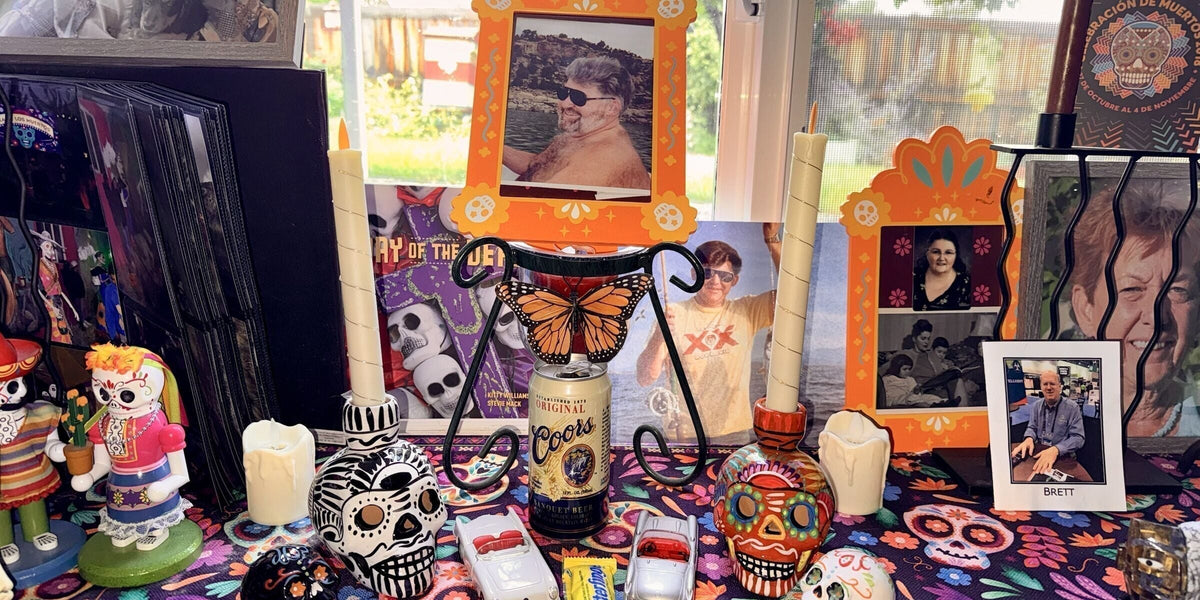
A Butterfinger, his favorite candy. Corvette miniatures, because that was his favorite car. Photographs of him in his happiest moments, driving his boat, deep-sea fishing. A coffee mug with his name on it. Chocolate-dipped Oreos.
And one thing I want to tell you about, because it says everything about how personal this gets. I set out a can of Coors Light with the pop-top turned at an angle, which was his signature move. He always knew which drink was his that way. I have been sober for over twenty-five years, so I do not buy beer and I do not keep alcohol in my house. My sister had kept one of his actual cans, the pop-top still turned at his angle, and she gave it to me for my ofrenda. Every year I set that same can out for him. It is his. It has always been his. That is the kind of small, exact, deeply personal thing an ofrenda is made for.
Whatever you set out, let it be that specific. The angle of a can. The candy bar. The song they hummed. Specificity is love.
When do you set up an ofrenda?
Most families build their ofrendas in the last days of October, so the altar is ready before the spirits arrive. Tradition holds that the souls of children come first, on November 1, and the souls of adults follow on November 2, which is why so many altars are finished and lit by the evening of October 31. The ofrenda stays up through November 2, and then it is put away until the next year.
Mine no longer gets put away. I have since built a permanent ofrenda in the windowsill above my writing desk, so I am surrounded by the people I love every day. But the Coors Light can and the Butterfingers still come out only for Día de Muertos, and on November 3, when the holiday is over, I eat the Butterfingers myself, in his honor.
What does it mean that we die twice?
There is an idea woven through Día de Muertos, and through my novel, that each of us dies twice. The first death is the physical one, the day the body lets go. The second comes later, at the last moment someone speaks our name out loud. After that, we are truly gone.
The ofrenda is how you hold off that second death. As long as your person has a seat at the table, their photo, a plate of the food they loved, their name said again this year, they are still here. Still remembered. Still ours.
My dad passed before either of my children was born. They never met him. And yet they miss him, and they will tell you they know him, because I have told them stories about him their whole lives. His laugh. His boat. His love for his friends and family. He has a seat at our table every year, and his name is spoken in our house all the time. That is the whole point. It is the idea at the very heart of Monarch of the Heart, that the people we love do not truly leave us, they live on in the ones who carry their stories forward. I do not build the ofrenda to say goodbye. I build it to make sure he never has to leave.
How do you build an ofrenda, step by step?
You can build a beautiful ofrenda on a single tabletop. Here is a simple way to start.
-
Choose your space. A table, a shelf, a dresser top. Cover it with a cloth you love.
-
Add height. If you can, stack a few boxes under the cloth to create levels. Traditional altars use tiers, but even two levels give the altar a sense of ascent.
-
Place your photos. Start with the people you are honoring. Everything else builds around them.
-
Bring the marigolds. Real or paper. Lay a few petals leading toward the altar.
-
Light it. Add your candles and, if you like, copal incense.
-
Set out water and salt. Small offerings for the journey.
-
Make it theirs. Add the food, drinks, and objects your loved ones cherished. This is the step that turns a table into a homecoming.
That is all it takes. You can add to it every year, the way I have.
Making it your own
There is no single correct ofrenda. Some are enormous and multi-tiered. Mine grows a little each year as I find new pieces of my dad to include, and as I have lost more of the people I love, their faces have joined his. Build the one that feels like the person you are welcoming home. They will know it is for them.
If you would like a companion for the season, my free reader’s travel guide walks the places and traditions behind the novel, and the Marigold Path and Ofrenda bracelets from my Courage Collection were made in this same spirit of remembrance. And if you have not met Rylee yet, you can read the first chapter free.
With much love for the journey,
Carrie
If this season is a heavy one for you, be gentle with yourself, and let someone you trust sit with you in it.