
What Is a Taller? Inside the Oaxaca Workshops Where Alebrijes Are Carved
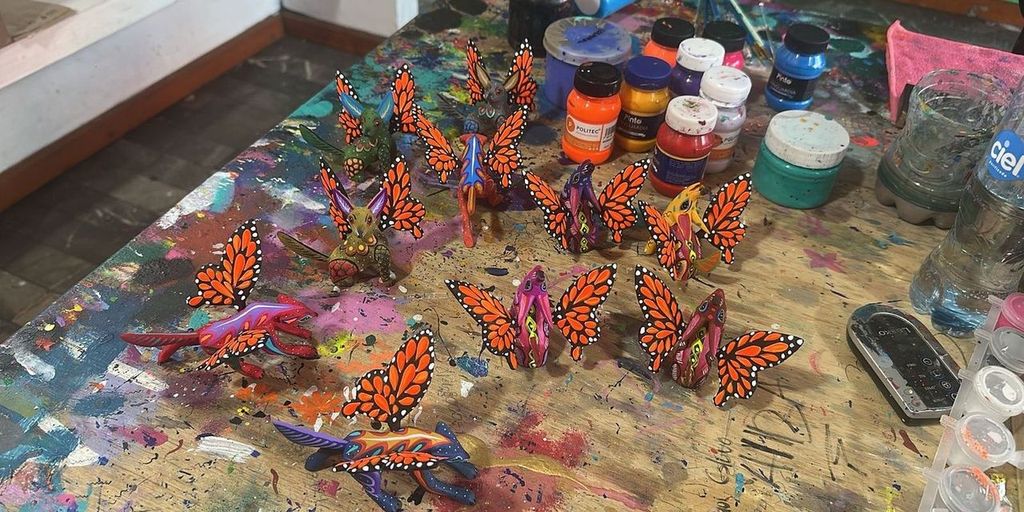
A taller is a family workshop, and in the alebrije villages of Oaxaca, it is where the whole craft lives. One generation teaches the next, and a single household can carry the entire process from a raw branch of wood to a finished, hand painted piece. It is also exactly where every Monarch & Marigold Spirit Guide begins.
What is a taller?
Taller is simply the Spanish word for workshop, but in Oaxaca it means something more personal. The wooden alebrije tradition is centered in a handful of villages outside Oaxaca City, and in most of them the work happens inside family homes rather than factories. A father who learned from his father. A daughter who has been painting since she could hold a brush. Cousins and neighbors pitching in during the busy seasons. The taller is the house, the workshop, and the family business, all at once.
How are alebrijes made?
There are really two kinds of alebrijes. The originals, born in Mexico City, are built from papier mâché, paper and paste shaped over a frame. The wooden alebrijes of Oaxaca, the kind made in the tallers, start as a branch of copal, a tree native to the region. Carvers often describe copal as having a male and a female form, with the softer wood easier to shape into large, intricate pieces. A carver studies the branch first, looking for the animal already hiding inside it, before a single cut is made. It is a little like the way Michelangelo is said to have described his sculptures, seeing the figure already inside the block of marble and simply setting it free. Then, with machetes, chisels, and small knives, the shape slowly comes out of the wood.
Once the figure is carved, it is left to dry, sometimes for weeks or months, so the wood will not crack. Then it is sanded and painted by hand, dot by dot and line by line, with the bold patterns that make an alebrije unmistakable. The painting often takes longer than the carving.
Who carves and who paints?
In many tallers, carving has traditionally fallen to the men and boys of the family, while the painting, often the more detailed half of the work, belongs to the women. It is not a rule, and plenty of families cross those lines, but it is common enough that you will hear it described that way again and again.
What moves me most is how often a finished piece carries only one name, even though three or four sets of hands may have shaped it. A whole family’s work, folded into a single signature.
Where does the word alebrije come from?
Alebrijes did not start in Oaxaca at all. They began in Mexico City in the 1930s, when a papier mâché artist named Pedro Linares dreamed of strange hybrid creatures during a fever and began building them out of paper and paste, a story I tell in what are alebrijes. Oaxacan woodcarvers, who already had a long tradition of carving animals, masks, and toys from copal, carried that same sense of the fantastical into wood. The name alebrije did not fully attach to their carvings until the 1990s. Two places, two materials, one shared imagination.
Where do my Spirit Guides come from?
I do not carve or paint a single piece myself, and I never want anyone to think I do. Each Spirit Guide started as an idea I brought to a taller in Oaxaca, monarch wings, a heart, a marigold worked into the pattern, and the artisans are the ones who turned that idea into something real in copal wood. I commissioned my first collection of Spirit Guides from a family workshop in Oaxaca called Blas Taller, and from that first collection I kept one for myself, the winged coyote I wrote about in finding your spirit animal.
I am now working with a new taller in Oaxaca on the next collection, and I hope to find a new taller for every collection I put out into the world. That way you can see the work of many different families, each with its own style, and the collection stays honest, handmade, and tied to the people who have carried this craft for generations.
How did the tallers find their way into Monarch of the Heart?
The tallers are part of what shaped María, the artist in Monarch of the Heart whose alebrijes carry monarch wings, a heart, and a cempasúchil flower, her signature style. In the book, María does both the carving and the painting herself, which is rarer in real life than the novel makes it look, and she gives every piece a name, a calling, a Spirit Signature, and a small blessing before she lets it go. That part is fiction. María is not any one artisan. But the reverence she brings to the work is the reverence I feel for the families who keep this craft alive.
If that kind of intention speaks to you, it is the same spirit behind every piece in the Spirit
Guides collection , each one hand carved and hand painted in Oaxaca, carrying the monarch, the heart, and the marigold.
With much love for the journey,
Carrie


