Finding Your Spirit Animal: A Guide to the Symbolism
A spirit animal is a creature whose traits reflect something true about who you are, or who you are becoming. Across many cultures and centuries, animals have carried meaning as guides, protectors, and mirrors. Choosing one that speaks to you can be a quiet, grounding act of self reflection. Here is a guide to the symbolism, and how to find yours.
What is a spirit animal?
The idea that an animal can reflect a person’s spirit appears in traditions all over the world. At its simplest, a spirit animal is a symbol, a creature whose nature echoes your own or holds a quality you are reaching for. It is less about belief and more about meaning, a way of naming who you are with an image you can carry.
It is worth knowing that the phrase spirit animal comes from sacred practices in specific Indigenous cultures, and many people now prefer to say animal guide or spirit guide out of respect for those traditions. That is part of why I call my own collection the Spirit Guides. Whatever words you use, the heart of it is the same, an animal that feels like it walks beside you
Where does the idea of an animal guide come from in Mexico?
Mexico has its own deep roots here. In parts of Mesoamerica, many people have long believed that each of us is born with an animal companion whose fate is tied to our own. In Oaxaca, some Zapotec traditions link that companion, sometimes called a tona, to the day you were born in the ancient ritual calendar, an animal believed to share your path through life.
The alebrije grew out of a very different story, one artist’s fever dream in Mexico City, which I wrote about in what are alebrijes. But when the carvers of Oaxaca took up alebrijes, the two ideas found each other. Today many people see an alebrije as a guardian, a fantastical creature that carries the traits of the animals it is made from.
What do common spirit animals symbolize?
Here are some of the most beloved animals, and the qualities they have long been
associated with.
Butterfly for transformation and rebirth. The monarch, which flies thousands of miles to
arrive in Mexico for Día de Muertos, adds remembrance and the journey home, which I
wrote about in the monarch migration.
Jaguar for courage and quiet power, an animal honored across ancient Mexico as a symbol
of strength.
Owl for wisdom and for seeing what others miss, especially in the dark.
Cat for independence, curiosity, and the confidence to walk your own path.
Coyote for adaptability and survival, the one who finds a way to thrive anywhere.
Turtle for patience and steadiness, carrying home wherever it goes.
Snake for renewal and transformation, shedding what no longer fits. In ancient Mexico, the
feathered serpent Quetzalcóatl was one of the most honored figures of all.
Dog for loyalty, protection, and unconditional love. In Mexican tradition, the hairless
xoloitzcuintle was believed to guide souls on their journey to the land of the dead.
Armadillo for protection and healthy boundaries, a gentle creature with its own armor.
Axolotl for regeneration and second chances. Native to the waters of Xochimilco, this little
salamander can regrow what it loses.
Hummingbird for joy, lightness, and resilience.
None of these meanings is fixed. The one that matters most is the meaning the animal holds for you.
How do you find the animal that feels like yours?
There are two ways in. The first is recognition. Which animal do you already feel like? The
second is longing. Which animal do you wish you moved through the world like? Both are
true answers, and they are often different.
So many of us spend years being what everyone else needs, the steady one, the caretaker,
the one who holds it all together. Sometimes the animal that calls to you is the one that
reminds you of who you were before all that, or who you are finally becoming. And
sometimes it is simply the creature that keeps showing up, in dreams, in art, on a walk,
quietly asking to be noticed.
Where did the idea for my Spirit Guides come from?
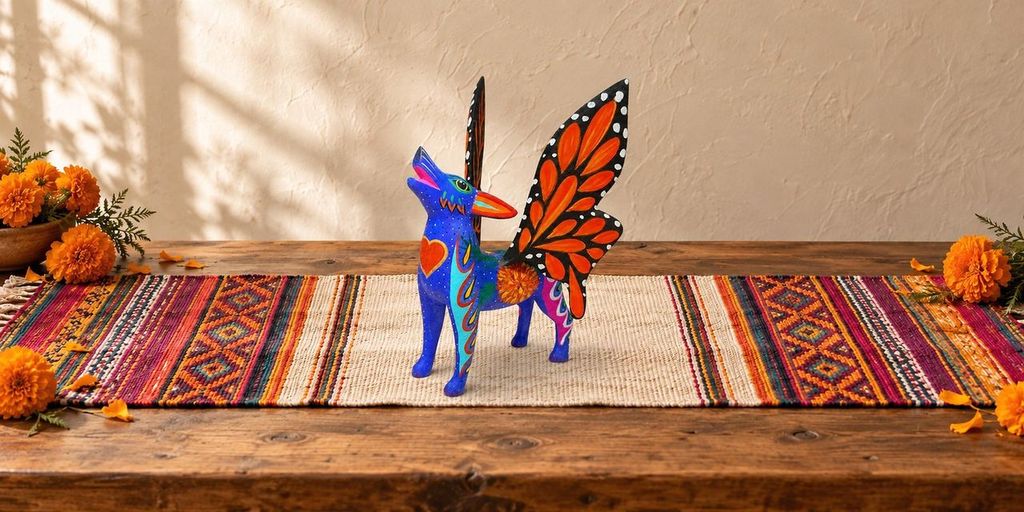
In Monarch of the Heart, the artist María gives her alebrijes monarch wings. That is where my Spirit Guides began. I wanted to bring her creatures off the page and into the world, each one carrying monarch wings, a heart, and a marigold, the symbols at the center of everything I make.
When the first six Spirit Guides arrived from Oaxaca, I kept one of them for myself, a blue winged coyote. The coyote is the survivor, the animal that adapts and keeps going no matter how the landscape changes, and the wings are the part that lets it rise above. I did not carve or paint it, the artisans of Oaxaca did, but I imagined it, and every time I look at it I remember why I started all of this.
To bring the collection to life, I reached out to a variety of tallers in Oaxaca, the family workshops where alebrijes are carved and painted, which I wrote about in what is a taller. I commissioned my first collection from one of them, and I am working now with the next.
My plan is to keep adding new collections from different tallers across Oaxaca, each with its
own signature style, so you can see the beautiful work of many different alebrije artists, not
just one.
Every Spirit Guide is hand carved and hand painted in Oaxaca. If you are looking for the one
that feels like yours, you can meet them all in the Spirit Guides collection.
Whichever animal calls to you, trust it. It was probably calling for a reason.
With much love for the journey,
Carrie